Build a thesis. Defend it. Reviewer 2 not included.
2–4 players or teams · 20–30 minutes · no card-game experience needed
The idea
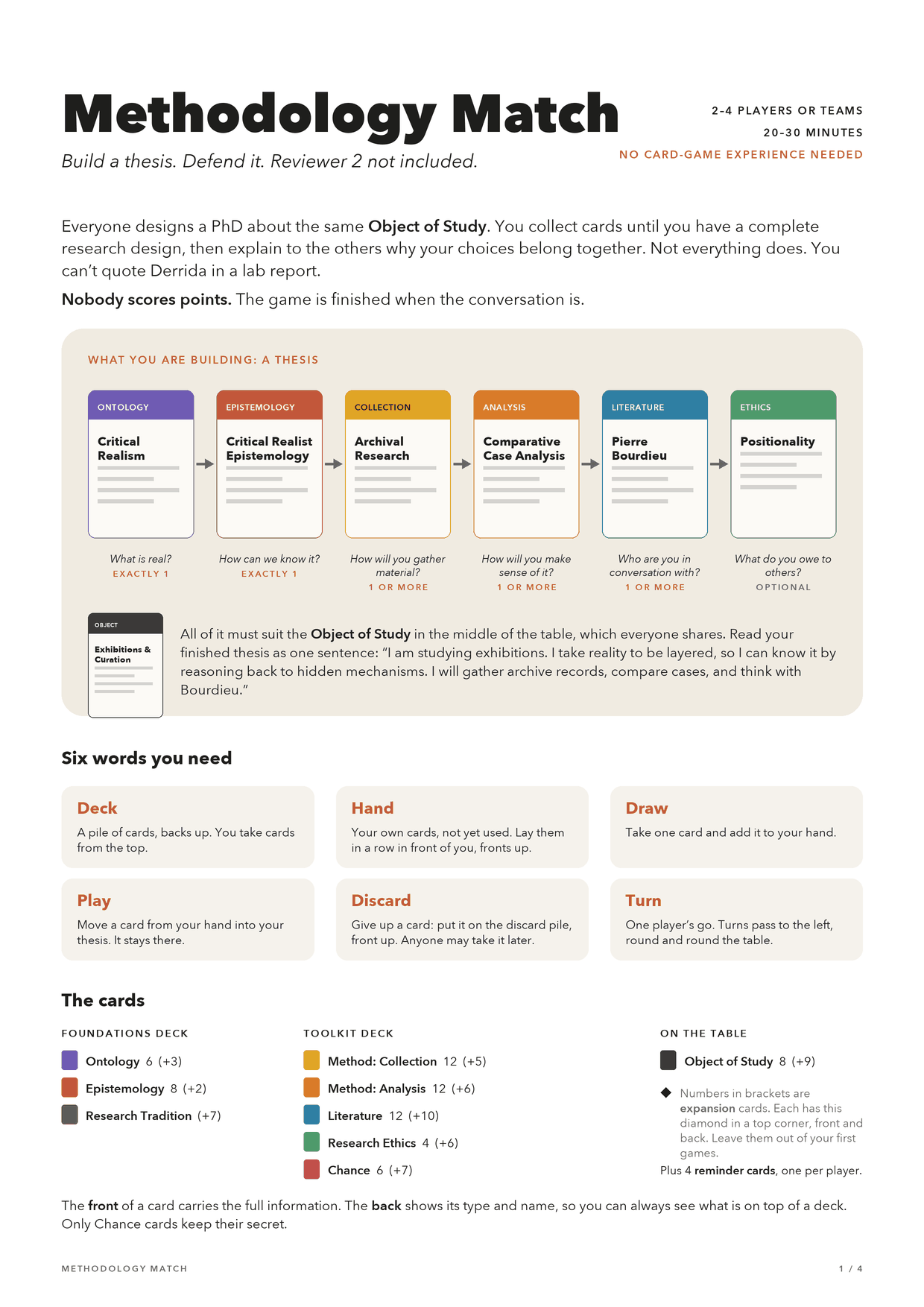
Everyone designs a PhD about the same Object of Study. You collect cards until you have a complete research design, then talk through with the others why your choices belong together. Not everything does. You can't quote Derrida in a lab report. Nobody scores points.
A thesis has five slots: Ontology (what is real? exactly 1), Epistemology (how can we know it? exactly 1), Method of Collection (1 or more), Method of Analysis (1 or more) and Literature (1 or more). Research Ethics is optional.
Six words you need
- Deck: a pile of cards, backs up. You take cards from the top.
- Hand: your own cards, not yet used. Lay them in a row in front of you, fronts up.
- Draw: take one card and add it to your hand.
- Play: move a card from your hand into your thesis. It stays there.
- Discard: give up a card: put it on the discard pile, front up. Anyone may take it later.
- Turn: one player's go. Turns pass to the left.
The cards
The front of a card has the full information. The back shows its type and name, so you can see what is on top of each deck. Chance backs keep their secret.
- Foundations deck: Ontology and Epistemology.
- Toolkit deck: Method (Collection), Method (Analysis), Literature, Research Ethics and Chance.
- Object of Study: one is used per game.
- Reminder cards: one per player. "On your turn" on one side, "Your thesis" on the other.
- Expansion cards have a small diamond in a top corner, front and back. Leave them out of your first games.
Setup
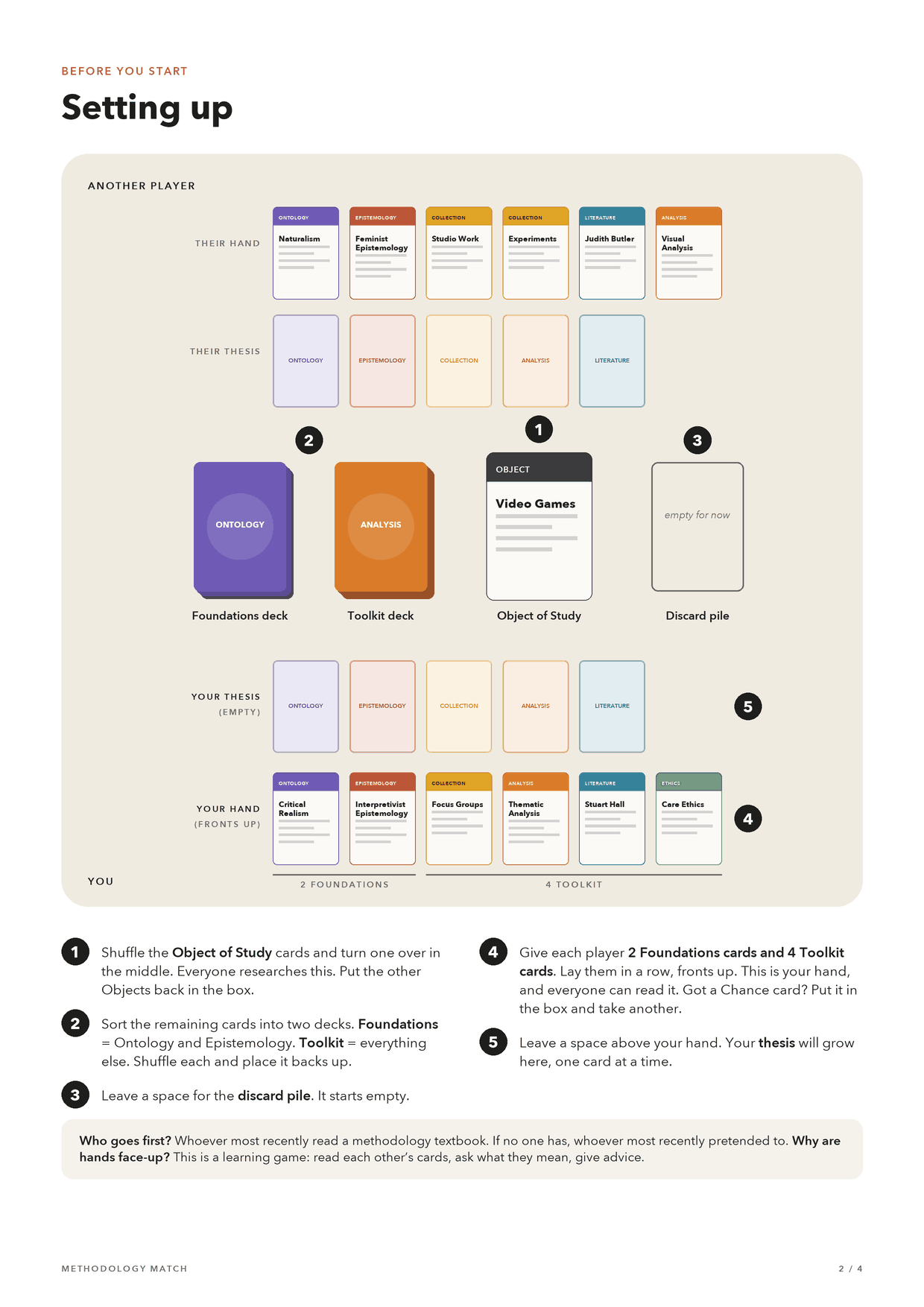
- Shuffle the Object of Study cards and turn one over in the middle. Put the rest in the box.
- Sort the remaining cards into the Foundations and Toolkit decks. Shuffle each and place it backs up.
- Leave a space for the discard pile. It starts empty.
- Give each player 2 Foundations cards and 4 Toolkit cards, laid in a row, fronts up. Got a Chance card? Box it and take another.
- Leave a space above your hand for your thesis.
Whoever most recently read a methodology textbook goes first. If no one has, whoever most recently pretended to.
Your turn
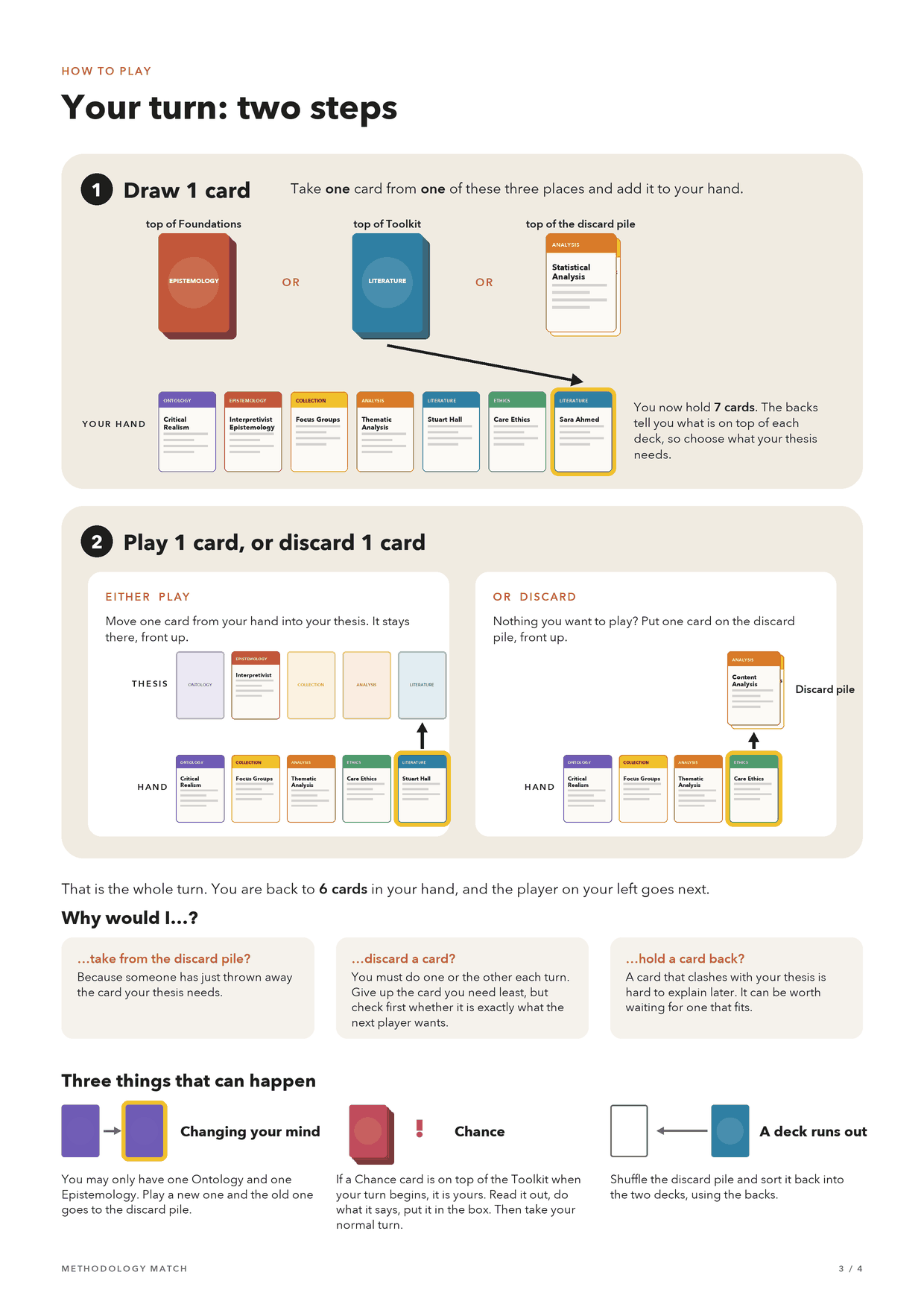
- Draw 1 card from the top of Foundations, the top of Toolkit, or the top of the discard pile.
- Play 1 card into your thesis, or discard 1 card.
You end every turn with 6 cards in your hand.
- Changing your mind: a new Ontology or Epistemology replaces the old one, which goes to the discard pile.
- Chance: if a Chance card is on top of the Toolkit when your turn begins, it is yours. Read it out, do what it says, put it in the box. Then take your normal turn.
- A deck runs out: shuffle the discard pile and sort it back into the two decks, using the backs.
Reading the matches
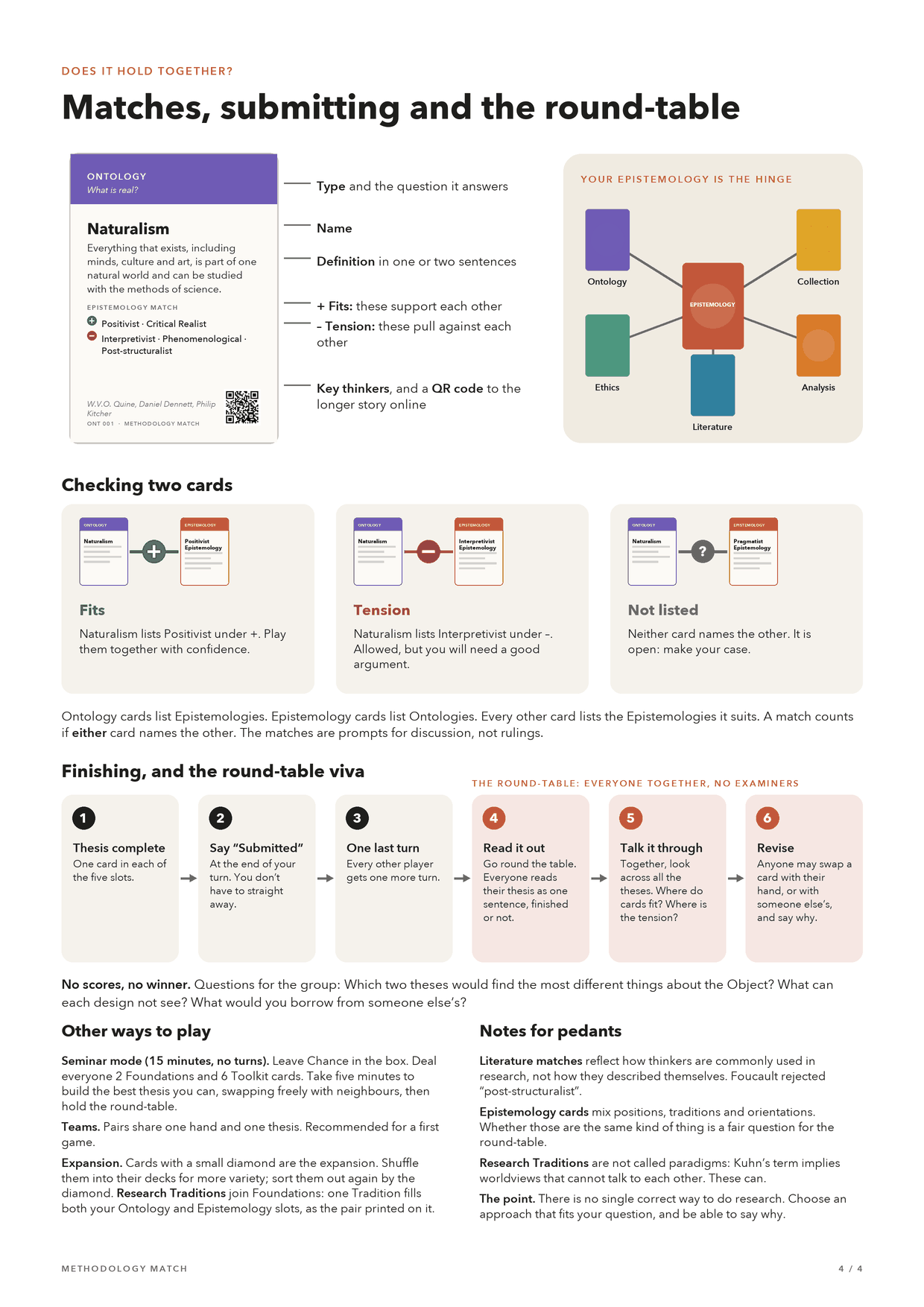
- + Fits: these support each other.
- – Tension: these pull against each other. Allowed, but be ready to say why.
- Not listed: open. Make your case.
Ontology cards list Epistemologies. Epistemology cards list Ontologies. Every other card lists the Epistemologies it suits, so your Epistemology is the hinge of the thesis. A match counts if either card names the other.
Finishing, and the round-table viva
When all five slots are filled you may end your turn by saying "Submitted". Every other player takes one last turn. Then the round-table begins. There are no examiners.
- Read it out. Go round the table. Everyone reads their thesis as one sentence, finished or not: "I am studying … I take reality to be … so I can know it by … I will gather … and analyse it with … in conversation with …"
- Talk it through. Together, look across all the theses. Where do cards fit? Where is the tension? Which two theses would find the most different things about the Object? What can each design not see?
- Revise. Anyone may swap a card with their hand, or with someone else's, and say why.
No scores, no winner.
Other ways to play
- Seminar mode (15 minutes, no turns): leave Chance in the box. Deal everyone 2 Foundations and 6 Toolkit cards. Take five minutes to build the best thesis you can, swapping freely with neighbours, then hold the round-table.
- Teams: pairs share one hand and one thesis. Recommended for a first game.
- Expansion: shuffle the diamond cards into their decks; sort them out again by the diamond. Research Traditions join Foundations: one Tradition fills both your Ontology and Epistemology slots, as the pair printed on it.
Notes for pedants
- Literature matches reflect how thinkers are commonly used in research, not how they described themselves. Foucault rejected "post-structuralist".
- Epistemology cards mix positions, traditions and orientations. Whether those are the same kind of thing is a fair question for the round-table.
- Research Traditions are not called paradigms, because Kuhn's term implies worldviews that cannot talk to each other. These can.
- The point: there is no single correct way to do research. Choose an approach that fits your question, and be able to say why.