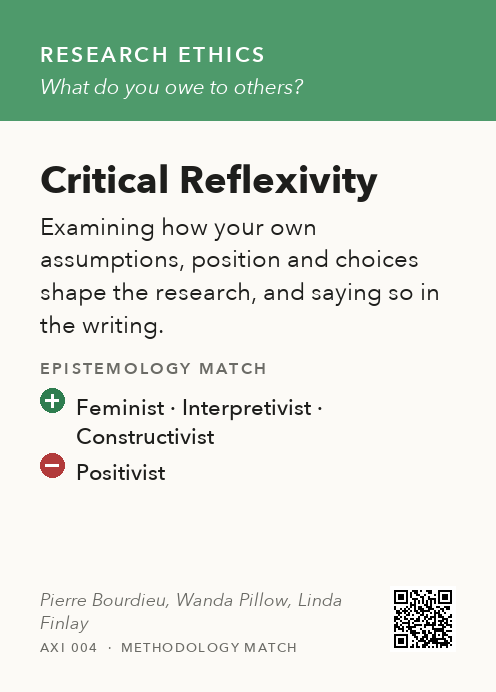
Examining how your own assumptions, position and choices shape the research, and saying so in the writing.
- +Fits Feminist Epistemology, Interpretivist Epistemology, Constructivist Epistemology
- –Tension with Positivist Epistemology
Key thinkers: Pierre Bourdieu, Wanda Pillow, Linda Finlay
The longer story
Here's a humbling thought: you are part of your own data. Critical reflexivity means examining how your assumptions, social position, and methodological choices shape your findings. It's not navel-gazing—it's acknowledging that the researcher isn't a neutral instrument. Your gender affects what people tell you. Your training shapes what you notice. Your theoretical commitments determine what counts as interesting. Making this explicit isn't weakness; it's rigour. The alternative is pretending to an objectivity you don't have. Reflexivity is standard practice in qualitative research because we've learned that unreflexive research hides its biases rather than eliminating them.