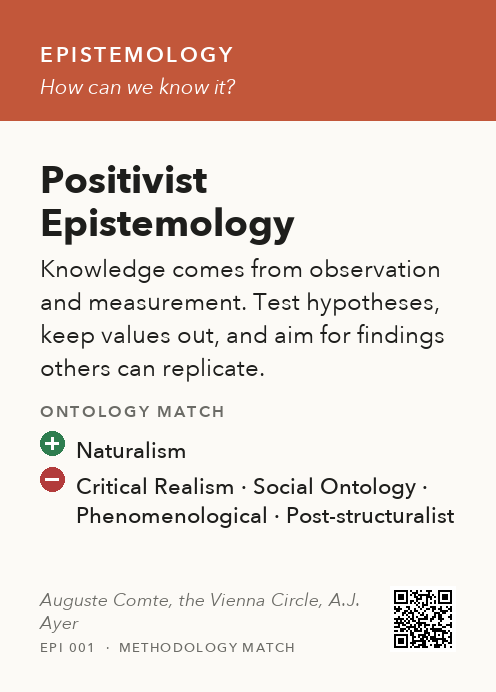
Knowledge comes from observation and measurement. Test hypotheses, keep values out, and aim for findings others can replicate.
- +Fits Naturalism
- –Tension with Critical Realism, Social Ontology, Phenomenological Ontology, Post-structuralist Ontology
Key thinkers: Auguste Comte, the Vienna Circle, A.J. Ayer
The longer story
Positivism has one simple, powerful idea: if you can't measure it, you don't really know it. Genuine knowledge comes from systematic observation, controlled experiment, careful measurement. Keep your values out of it—facts are facts. Count things. Find patterns. Test hypotheses. Replicate. It's the epistemology behind every experiment, every survey, every statistical analysis. Critics say it misses meaning, ignores context, pretends objectivity that isn't possible. Defenders say it's the only way to get knowledge you can actually rely on. If you want generalisable findings that others can check and build on, this is the epistemology that delivers—within its limits.