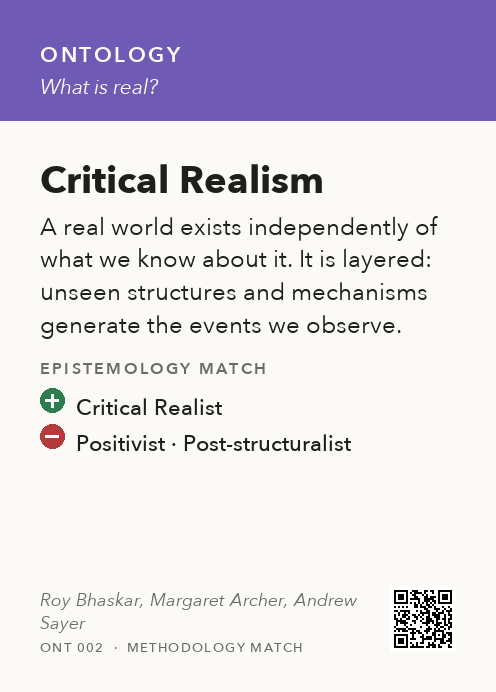
A real world exists independently of what we know about it. It is layered: unseen structures and mechanisms generate the events we observe.
- +Fits Critical Realist Epistemology
- –Tension with Positivist Epistemology, Post-structuralist Epistemology
Key thinkers: Roy Bhaskar, Margaret Archer, Andrew Sayer
The longer story
Reality is layered, like an onion, and most of what matters is invisible. Critical realism says: yes, there's a real world out there, but what we observe is just the surface—events generated by deeper mechanisms we can't see directly. Capitalism is real, even though you can't photograph it. Patriarchy is real. These structures exist and do things whether or not we're looking. So research becomes detective work: you see effects at the surface and reason backwards to what must be causing them. The method is called retroduction—'what would have to be true for this to happen?' It's powerful for studying institutions, industries, anything where hidden forces shape visible outcomes.