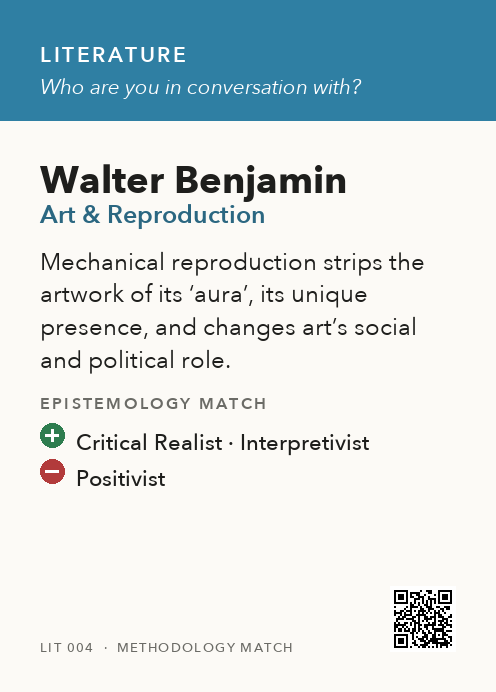
Mechanical reproduction strips the artwork of its ‘aura’, its unique presence, and changes art’s social and political role.
- +Fits Critical Realist Epistemology, Interpretivist Epistemology
- –Tension with Positivist Epistemology
The longer story
Benjamin asked what happens to art when it can be mechanically reproduced. His answer: it loses 'aura'—that sense of unique presence in time and space. The original painting has it; the photograph doesn't. Photography and film changed art fundamentally, potentially democratising access but also enabling fascist spectacle. Benjamin's analysis of the artwork in the age of mechanical reproduction is essential for understanding how reproduction technologies—now digital—transform aesthetic experience. What happens to aura in the age of infinite copies? Does the question even still apply?