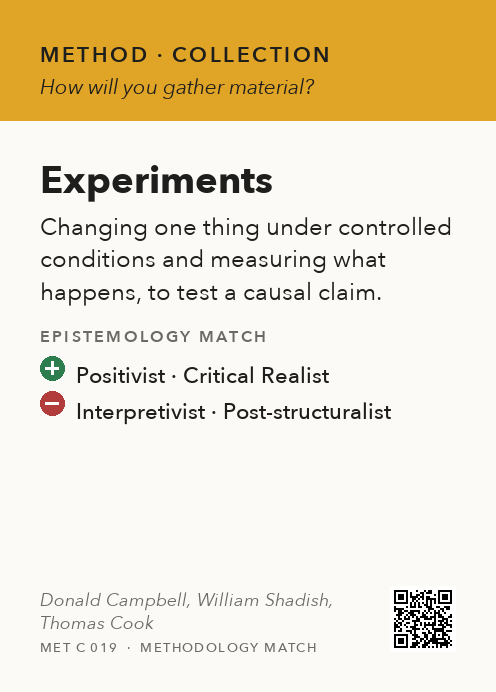
Changing one thing under controlled conditions and measuring what happens, to test a causal claim.
- +Fits Positivist Epistemology, Critical Realist Epistemology
- –Tension with Interpretivist Epistemology, Post-structuralist Epistemology
Key thinkers: Donald Campbell, William Shadish, Thomas Cook
The longer story
Experimental protocols specify exactly what happens in an experiment—same procedure every time, variations only where you're testing differences. Control is the point: if everything else is held constant, differences in outcome must be due to differences you manipulated. Lab settings maximise control; field settings sacrifice some control for ecological validity. Write protocols in enough detail that someone else could replicate exactly what you did. Transparency enables others to check and build on your work.